All posts by Ejike Udeogu

The Rationale Behind President Trump’s Tariff Initiatives: A Critical Examination

Since his 2016 campaign, President Donald Trump championed an aggressive trade policy aimed at reducing trade deficits, reviving domestic manufacturing, and strengthening national economic security. His administration’s tariff initiatives—particularly targeting China, the European Union, Mexico, and Canada—were framed as necessary measures to rectify long-standing economic imbalances. This article critically examines the rationale behind Trump’s tariff initiatives by analyzing key economic indicators, including the U.S. trade deficit, national debt, industrial production growth, and corporate profits.
The U.S. Trade Deficit and the “America First” Trade Policy
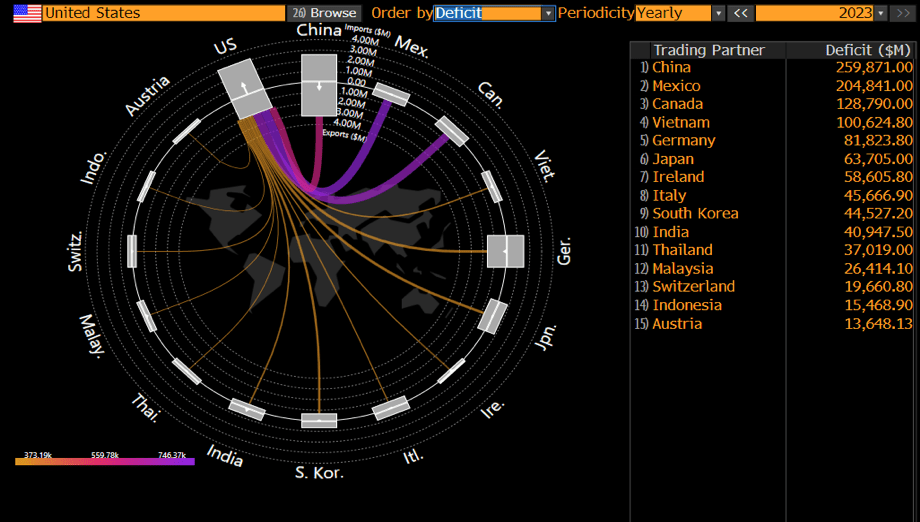
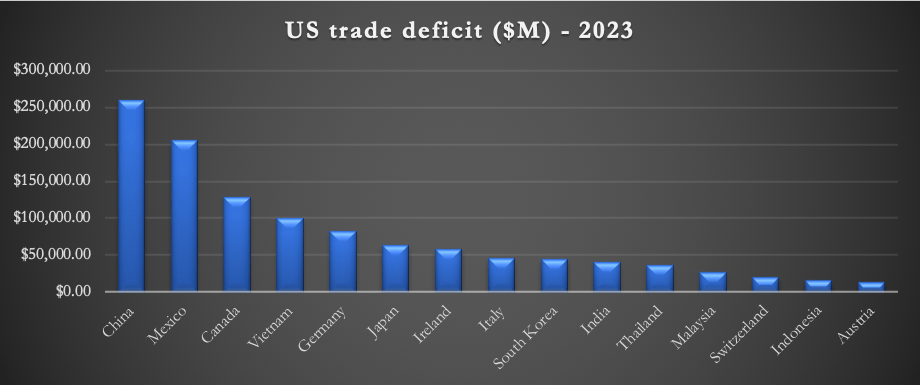
A central justification for Trump’s tariffs was the persistent U.S. trade deficit, especially with China. The Trump administration argued that the United States was being exploited through unfair trade deals and practices by the Chinese government, including currency manipulation and subsidies, which provided a competitive edge to Chinese exports. These advantages contributed to the decline in U.S. exports relative to the rising importation of cheaper Chinese goods, showcasing a significant imbalance in trade. This situation not only affected various sectors, such as manufacturing and agriculture, but also sparked concerns about job losses for American workers who found it increasingly difficult to compete with lower-priced imports. Deficits with other U.S. trading partners, including Mexico, Canada, and the European Union, also remained high over the years, largely due to declining U.S. exports to these regions. The overall impact of these trade dynamics raised debates about the effectiveness of U.S. trade policies and the need for comprehensive reforms to ensure a fairer trading environment that could benefit American industries and workers alike.

Burgeoning National Debt

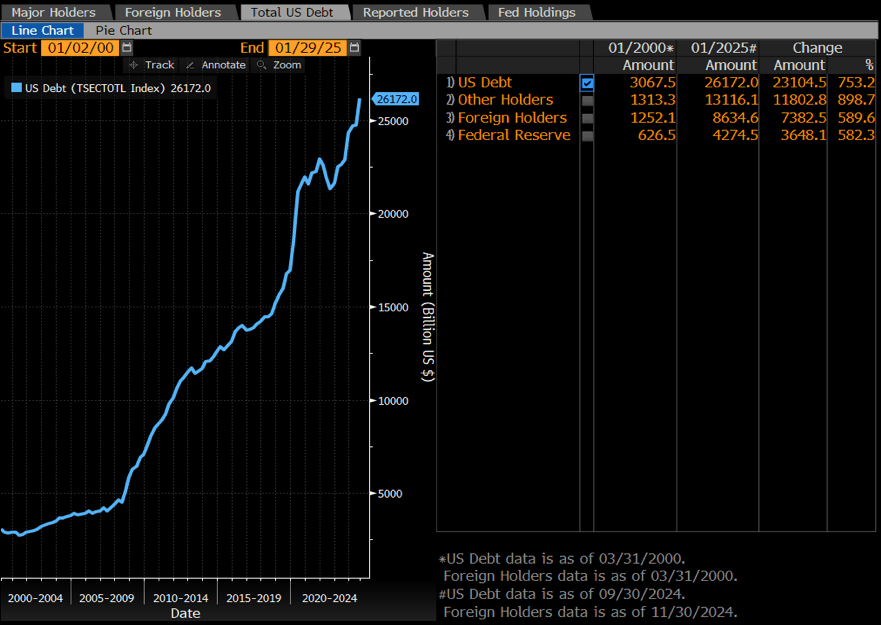
Another economic backdrop to Trump’s tariff initiatives was the rising national debt, a pressing issue that has persisted for years and raised alarms among economists and policymakers alike. The current Treasury Secretary, Scott Bessent, during his confirmation hearings, alluded to this concern, emphasizing the need for sustainable fiscal policies. The Trump administration has strategically positioned tariffs as revenue-generating mechanisms that could potentially offset some of the growing debt, thereby reducing dependency on foreign borrowing and enhancing domestic economic stability. This approach aimed to encourage American manufacturing and promote job creation while addressing the ever-increasing national debt. As of 2023, total U.S. debt stands at approximately $28.83 trillion, equivalent to 123% of GDP, which highlights the urgency for innovative strategies to manage and reduce the fiscal burden on future generations.
Manufacturing decline, the result of cheap imports?

One of Trump’s strongest appeals to voters was the promise to restore American manufacturing, a sector that many perceived as vital to the nation’s economic strength and independence. His administration asserted that tariffs would shift consumption toward domestic goods and pressure companies to bring production back to the U.S., thereby reviving industrial output and creating countless jobs for American workers. This strategy aimed to not only revitalize factories but also to bolster local economies by encouraging consumer spending on homegrown products. Indeed, current figures show that average manufacturing production output growth post-COVID has stagnated, following an initial increase during Trump’s first term between 2017-2020, which raised questions about the sustainability of such initiatives and the long-term impact on American competitiveness in a global market increasingly dominated by automation and innovative technologies. As stakeholders analyze these trends, the future of American manufacturing remains a topic of intense debate and concern.
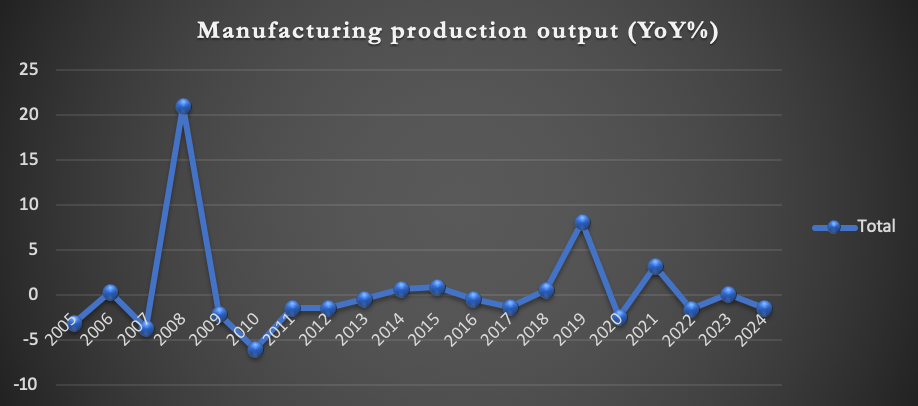
Manufacturing output initially saw a boost, particularly in industries benefiting from protectionist policies during the administration’s first term between 2018-2020, which encouraged domestic production and reduced reliance on foreign imports. However, by 2019—before the COVID-19 pandemic—manufacturing growth had stagnated, in part due to higher costs for imported raw materials such as steel and aluminium, which had seen significant price increases as global supply chains were disrupted. Additionally, the rise in energy prices, resulting from the Russia-Ukraine war, placed further strain on manufacturers already grappling with escalating operational costs. The previous administration’s ineffective energy policies contributed to this volatile energy landscape, creating an environment where businesses struggled to maintain profit margins. Collectively, these factors created a challenging climate for the manufacturing sector, which now faced the dual pressures of surging input costs and an increasingly uncertain economic outlook that hindered expansion efforts.

Corporate Profits and Industrial Production Growth

Figures on average corporate after-tax profits indicate an increase during Trump’s first term, particularly between 2020 and 2021. This upward trend can be attributed to several factors that played a significant role in shaping the economic landscape of that era. Tariffs, implemented as part of a broader trade strategy, could be credited with boosting domestic production, thereby providing a protective shield for certain industries and consequently enhancing corporate profits. While some sectors, particularly those reliant on foreign inputs, faced rising production costs due to trade policies and supply chain disruptions, others, such as steel manufacturing, temporarily benefited from reduced competition and increased demand for domestic products. This dynamic interaction between increased tariffs and domestic production led to notable shifts in profitability across various industries. Overall, growth in key industries offset declines in others, resulting in a net positive effect on corporate profits that reflected a complex economic environment. Additionally, corporate profits were bolstered by the tax cuts initiated by the Trump administration between 2017 and 2021, which aimed to stimulate investment and consumer spending; these cuts not only increased disposable income for businesses but also encouraged reinvestment into operations and workforce expansion, further contributing to the positive trend observed in corporate profitability during this time frame.

Conclusion: The Legacy of Trump’s Tariff Policy

In conclusion, the Trump administration’s tariff initiatives are driven by legitimate concerns about trade imbalances and economic security, reflecting a growing recognition of the need to protect domestic industries from unfair competition. While there were short-term gains in specific industries, such as steel and aluminum, alongside losses in others, particularly those reliant on imported goods, broader economic indicators suggest that tariffs, if applied judiciously and strategically, could contribute to a sustained manufacturing resurgence. This resurgence could stimulate job creation within the manufacturing sector, bolster local economies, and encourage innovation among domestic producers. Furthermore, a decrease in the trade deficit, achieved through a more balanced approach to trade policies, could enhance national economic stability and strengthen the United States’ position in the global market. Ultimately, the long-term effectiveness of these tariffs would depend on careful oversight and adjustments to ensure that the measures do not inadvertently harm other critical sectors of the economy.

Overall, one thing is certain: doing nothing is not a viable option if America is serious about reducing its burgeoning debt, trade deficits, and declining manufacturing output. In the current global economic landscape, where competition is fierce and markets are increasingly interconnected, it becomes crucial for the United States to adopt proactive measures. Particularly in the context of China’s ‘deliberate’ currency devaluation practices, which undermine fair competition, government subsidizations that distort market dynamics, and relatively low labour costs that make it difficult for American manufacturers to compete, protective measures such as tariffs remain a contentious but necessary tool in shaping U.S. trade policy and countering the Chinese. These tariffs not only serve to protect domestic industries and jobs but also encourage a shift towards innovation and sustainable practices, ultimately fostering a more resilient economy that can withstand future challenges. As such, a thoughtful approach to trade policies is imperative for reviving American manufacturing and ensuring long-term economic stability.
What are we actually measuring?

                                                                                                                                                                                                                                                          Post by Ejike Udeogu       

In the article published by the Economist (12 April, 2014), Nigeria was remarked to have overtaken South Africa as the biggest economy in Africa; as a result of her GDP revision. The value of Nigeria’s gross domestic output surpassed South Africa’s by over $150 billion. Unarguably, as the report also pointed out, the revised GDP paints a truer picture of Nigeria’s economy, albeit only on the final gross national output. The gross national output or product (GDP), as defined by the OECD, is the aggregate measure of the sum of the gross values added by all resident institutional units engaged in production in a given year. Nowadays, this measure is often used by economists to measure the so called ‘economic growth’. The GDP estimates are now commonly used to measure the economic performance of a whole country. In economics jargon therefore, Nigeria’s economy  is ‘growing’. 

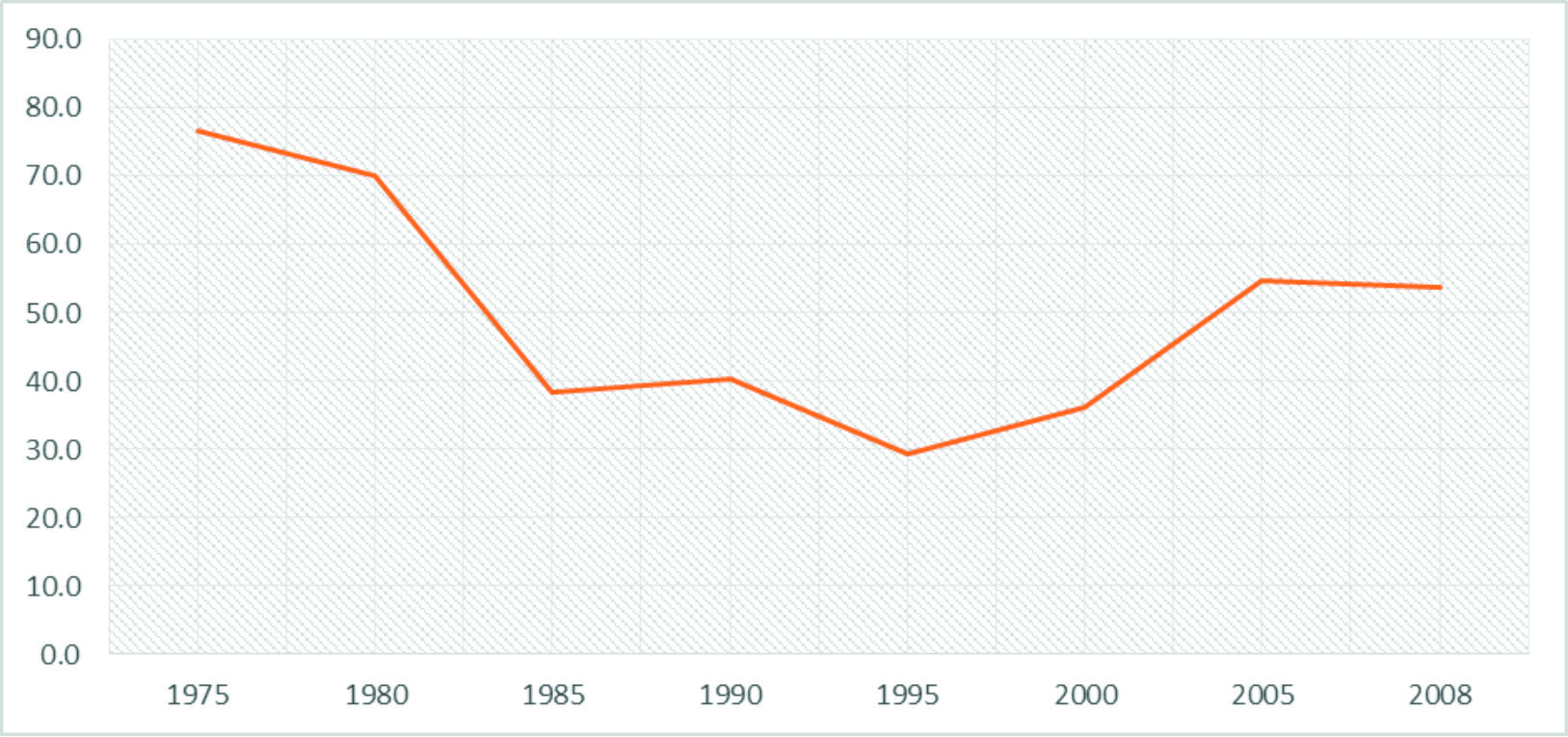
Nevertheless, in the midst of these heightened economic growths, the truth is that a large proportion of the population are still living in abject poverty. Over 60% of Nigerians live below $1.25 a day (according to World Bank’s 2013 estimate). In reality though, over 80% of Nigerians are living below $2 a day. Though national unemployment is shown to be in the mid-twenties, the real fact is that youth’s (15s-25s) unemployment rate is in the mid-fifties (that is five out of every ten youths are probably unemployed). Furthermore, the country’s manufacturing capacity utilisation is ominously appalling. The manufacturing capacity utilisation has been consistently below the averages obtained in other emerging economies (Fig. 1). As a result, productivity is very low in the country.

Figure 1. Manufacturing capacity utilisation

     utilization

Also, the country is one of the most unequal societies in the world, with a Gini coefficient of 48.8%. Share of the national income derived from taxes on income of the highest ten per cent earners (a very small proportion of the population) have increased over the years (it is currently around 40% of the national income). While those from the majority (over 50%) of the population who are in the lowest 20% income bracket, constitute less than five per cent of national income (this has been declining over the years; see Fig. 2 below). This shows that the income of the top ten per cent have been increasing whilst that of the lowest 20% have stagnated or decreased over the same periods.

      Figure 2. National income contribution

    inequality

More worrying is the rate of compensation to wage labourers. The rate of growth of compensations to wage labourers have fallen short of the rate of increases in prices. To emphasise, 100 Nigerian naira will buy less items these days than it could procure ten or even five years ago. The income compensation, measured against the increasing national output, paints a rather worrying picture (Fig. 3 below).

    Figure 3. Employee compensation (% of GDP)

    compensation

Therefore, in all these hullabaloo, what are we actually trying to measure? While the illusory indicator of growth, the GDP estimate is increasing, the real indicators of development – high employment rate, lower poverty levels, and decreasing income equality, still remain a mirage. The country may be a giant, but it is still poor. Nigeria ranks 153rd out of 187 countries in the UN’s Human Development Index. The country’s economic and social development still remain far below the average for poor countries. For instance, life expectancy at birth in Nigeria is only 52.3 years while the average for low income countries is 59.1 years. Under-five mortality rate is at 143 per 1,000 live births in Nigeria while for low income countries, the average is 110 per 1000.

Therefore, it is pertinent that policy makers in Nigeria are not deceived by the growing economy, for it is rather an illusion. Let Nigeria celebrate its new-found ephemeral status for a moment but then she needs to wake up and get hands-on with the task of addressing the real issues blighting her over 160 million people if she truly wants to live up as Africa’s numero uno. 

Pouring a new wine in an old wineskin: Why the new industrial revolution plan in Nigeria may not succeed

The Nigerian government recently earmarked over quarter of a trillion naira for the National Enterprise Development Programme (NEDEP). The programme, whose main purpose is to generate around five million employment in the economy between 2013 and 2015, will support Micro, Small and Medium Scale Enterprises (MSMEs) with skills training, entrepreneurship training/business development service (BDS) and access to finance.

Though a laudable project in every aspect, and designed with all good intentions, this project may not succeed in stimulating the desired level of growth in real capital accumulation that will be sufficiently adequate in lifting Nigeria out of all the economic quandaries that she has been mired in. This is largely because the MSMEs, which currently represents 96 per cent of the businesses in Nigeria and which contributes over 70 per cent of the national employment, suffer from some peculiar structural problems which are continually entrenched by the neoliberal ideologies that underpin the global economic structure, and which the new programme has erroneously also overlooked.

Since the mid-1980s, neoliberal abstractions, backed by imperialist organisations (IMF, World Bank and WTO), have determined the economic policies pursued by national governments in developing countries. Chief among these policies have been, deregulation, liberalisation, privatisation and fiscal discipline. Interest rates have been deregulated, capital accounts liberalised, tariffs and other trade barriers eliminated and public entities privatised.

These policies enthroned Western ideology of a mini-state and market-led strategies were seen as the panacea for the pervasive economic decadence in less developing countries. Nevertheless, evidences have shown these neoliberal abstractions to be flawed and based on unfounded logic. According to J. M. Keynes, the mainstream theory represents the way in which we should like our economy to behave. In other words, they don’t represent reality. In the words of a renowned American economists, Joseph Stiglitz, neoliberalism (structural adjustment programme) is a flawed policy that shouldn’t have been pursued in most developing economies in the first place.

The many problems associated with neoliberal policies have been traced to the unsoundness of mainstream theories that influenced these economic policies. Several texts, such as the General theory by Keynes, and the Economics of global turbulence by Brenner, have lucidly expounded the flaws of mainstream abstractions; any keen economist should endeavour to read these texts. According to Brenner, the inadequacy of mainstream theories derive from their inability to design a coherent theory of capital accumulation.

Given that capital accumulation is the bedrock of development in any economy; with growing rate of investment, there will be a growing number of people in employment, which means less people in poverty, inadequate analysis of this phenomenon thus poses a serious consequence for the development of the overall economy. That neoliberalism is a failed strategy is no longer a new fact. The disappointing economic performances of many developing economies that adopted this strategy attests to the fact that neoliberalism didn’t provide answers to the stagnating rate of capital accumulation in their real economies. These disappointing outcomes also underscores Brenner’s observation that mainstream theories have not articulated a coherent theory that comprehensibly explains the accumulation process in a modern capitalist system. The issue here is that most new plans aimed at resuscitating ailing economies often still blindly accommodate these flawed neoliberal policies.

My argument here, without further divagations, is that the new development plan being implemented using the structures of neoliberalism may not be able to revive the stagnant Nigeria economy because the neoliberal structures contain inconsistent or contradictory tendencies that undermine the ability of the peculiar capital-assets/processes in periphery economies like Nigeria from reproducing adequate returns that will ensure their continual existence and growth.In a nutshell, my argument is that the existence of unfettered trade and capital mobility poses significant risks to the valorisation of peripheral high-cost backward production processes in Nigeria.

According to Karl Marx, the capitalist production process has a natural tendency to centralise, due to the ebb and flow of capital that is a constant feature of accumulation. The centralisation of production process, on its part, does not bode well for high-cost processes. In the modern economic system, we have witnessed the centralisation of the production process in various scale (the rise of big multinationals). Interestingly, many of these centralised processes tend to be owned or concentrated in core economies. The implication has been the inability of the high-cost processes in periphery economies to grow. This is due the competitive pressure in the global market that produces downward pressures on prices forcing high-cost processes to be unable to extract adequate returns from their activities (in many cases, the peripheral agrarian processes are subordinated to the dominance of the advanced capitals (MNCs) in the core). This ultimately poses significant cost on the expansion and growth potentials of peripheral processes.

To clearly understand the uneven competition between these two bipolar processes, we need to comprehend the mountainous obstacles faced by most MSMEs in Nigeria. The peripheral backward processes (the MSMEs of Nigeria) suffer from inadequate access to cheap energy, distribution networks and other essential amenities that are taken for granted in most advanced economies (cheap and extra fast broadband connections, security, water and sanitation). These factors constitute to increased cost of production to these MSMEs. Allowing free and unfettered trade, which neoliberalism advocates, pitches these high cost processes in peripheries against low cost processes in the core. The end result is the inability of the high-cost processes to grow properly. Additionally, unfettered capital movement, especially of liquid capital, does not bode well for enterprises in recipient countries. This is because these liquid inflows precipitate high interest rates, which in turn further inflates borrowing costs for local firms. Weak judicial system causes poor contract enforcement, which reflects also in the high rate of interest being charged by financial institutions. Ineffective demand, often intensified by exorbitant medical costs which are almost fully borne by private individuals in Nigeria also hampers the ability of capital assets to earn sufficient returns which will ensure their continued growth and expansion. These issues vary across national border and the fact remains that processes in core economies are often spared these profit decimating factors.

To conclude, if these structural issues, unfettered trade and capital mobility, are not adequately addressed, the new development programme may not succeed in addressing the underdevelopment in Nigeria. Leaving the status quo and trudging along with the new plan is more like the proverbial saying of pouring a new wine in an old wineskin. The old wineskin may not be able to hold the new contents or in some cases may contaminate the sweet taste of the new wine. The fundamental structural problems undermining the ability of MSMEs in Nigeria from growing should first and foremost be addressed if Nigeria seriously wants to achieve a sustainable economic development.