
Tag Archives: Nigeria

What are we actually measuring?

                                                                                                                                                                                                                                                          Post by Ejike Udeogu       

In the article published by the Economist (12 April, 2014), Nigeria was remarked to have overtaken South Africa as the biggest economy in Africa; as a result of her GDP revision. The value of Nigeria’s gross domestic output surpassed South Africa’s by over $150 billion. Unarguably, as the report also pointed out, the revised GDP paints a truer picture of Nigeria’s economy, albeit only on the final gross national output. The gross national output or product (GDP), as defined by the OECD, is the aggregate measure of the sum of the gross values added by all resident institutional units engaged in production in a given year. Nowadays, this measure is often used by economists to measure the so called ‘economic growth’. The GDP estimates are now commonly used to measure the economic performance of a whole country. In economics jargon therefore, Nigeria’s economy  is ‘growing’. 

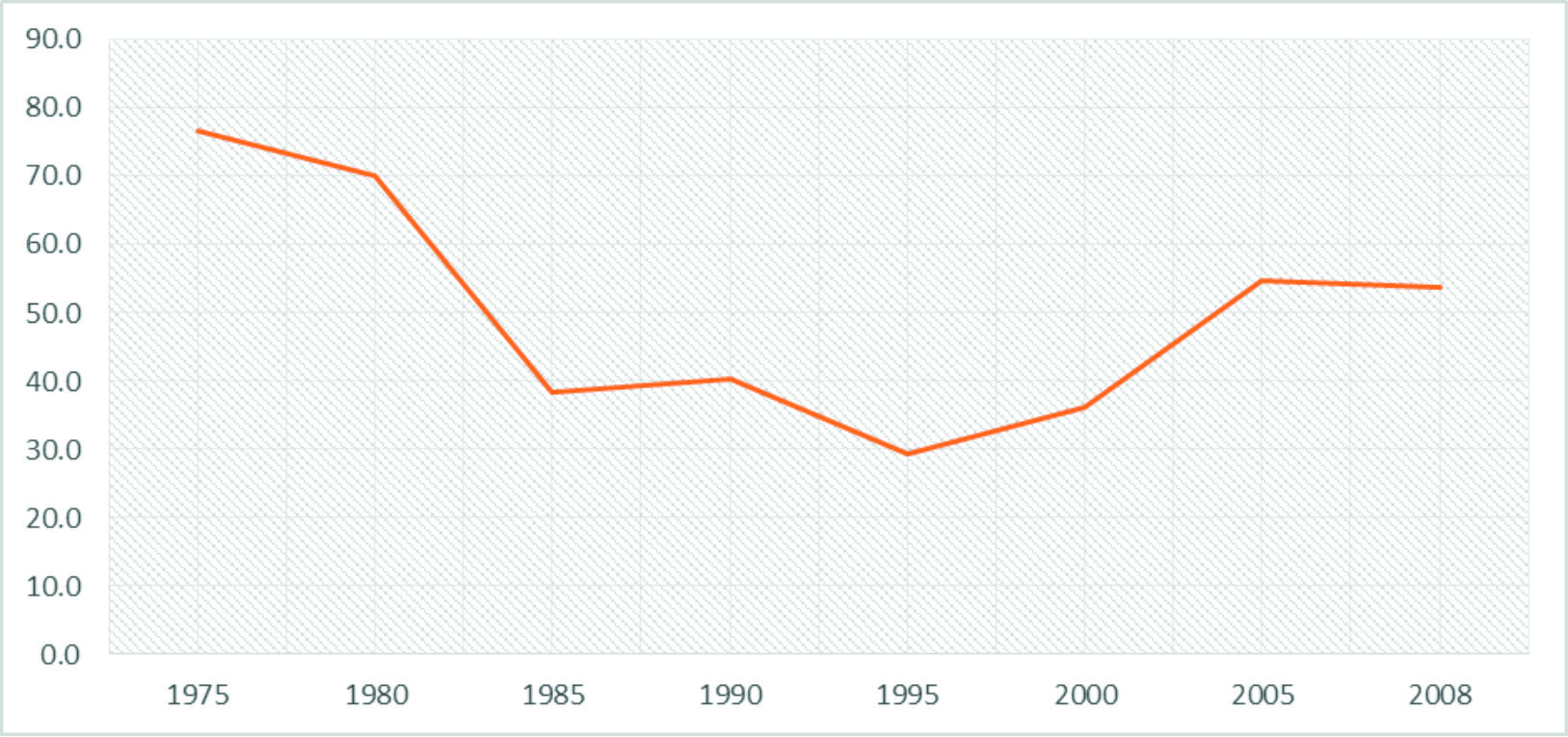
Nevertheless, in the midst of these heightened economic growths, the truth is that a large proportion of the population are still living in abject poverty. Over 60% of Nigerians live below $1.25 a day (according to World Bank’s 2013 estimate). In reality though, over 80% of Nigerians are living below $2 a day. Though national unemployment is shown to be in the mid-twenties, the real fact is that youth’s (15s-25s) unemployment rate is in the mid-fifties (that is five out of every ten youths are probably unemployed). Furthermore, the country’s manufacturing capacity utilisation is ominously appalling. The manufacturing capacity utilisation has been consistently below the averages obtained in other emerging economies (Fig. 1). As a result, productivity is very low in the country.

Figure 1. Manufacturing capacity utilisation
     utilization

Also, the country is one of the most unequal societies in the world, with a Gini coefficient of 48.8%. Share of the national income derived from taxes on income of the highest ten per cent earners (a very small proportion of the population) have increased over the years (it is currently around 40% of the national income). While those from the majority (over 50%) of the population who are in the lowest 20% income bracket, constitute less than five per cent of national income (this has been declining over the years; see Fig. 2 below). This shows that the income of the top ten per cent have been increasing whilst that of the lowest 20% have stagnated or decreased over the same periods.

      Figure 2. National income contribution

    inequality

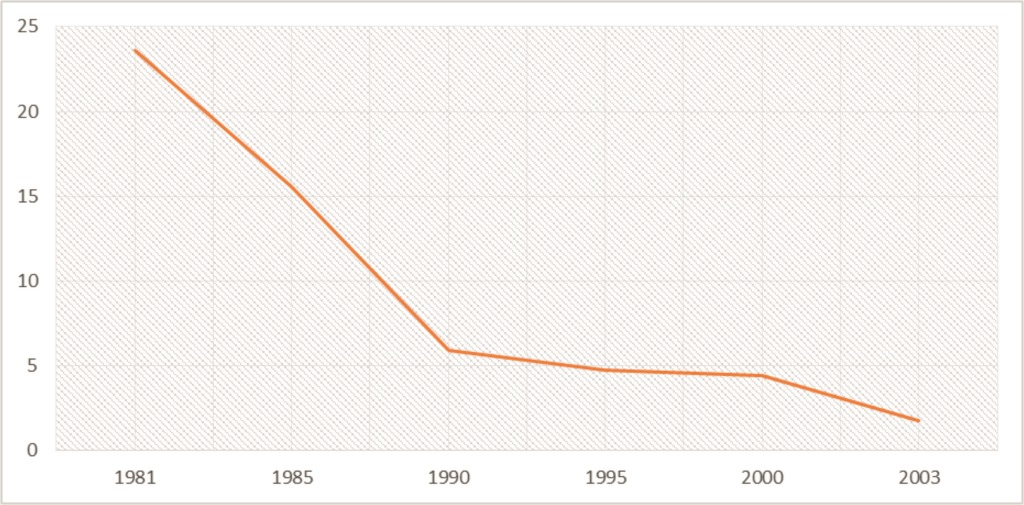
More worrying is the rate of compensation to wage labourers. The rate of growth of compensations to wage labourers have fallen short of the rate of increases in prices. To emphasise, 100 Nigerian naira will buy less items these days than it could procure ten or even five years ago. The income compensation, measured against the increasing national output, paints a rather worrying picture (Fig. 3 below).

    Figure 3. Employee compensation (% of GDP)
    compensation

Therefore, in all these hullabaloo, what are we actually trying to measure? While the illusory indicator of growth, the GDP estimate is increasing, the real indicators of development – high employment rate, lower poverty levels, and decreasing income equality, still remain a mirage. The country may be a giant, but it is still poor. Nigeria ranks 153rd out of 187 countries in the UN’s Human Development Index. The country’s economic and social development still remain far below the average for poor countries. For instance, life expectancy at birth in Nigeria is only 52.3 years while the average for low income countries is 59.1 years. Under-five mortality rate is at 143 per 1,000 live births in Nigeria while for low income countries, the average is 110 per 1000.

Therefore, it is pertinent that policy makers in Nigeria are not deceived by the growing economy, for it is rather an illusion. Let Nigeria celebrate its new-found ephemeral status for a moment but then she needs to wake up and get hands-on with the task of addressing the real issues blighting her over 160 million people if she truly wants to live up as Africa’s numero uno. 

Pouring a new wine in an old wineskin: Why the new industrial revolution plan in Nigeria may not succeed

The Nigerian government recently earmarked over quarter of a trillion naira for the National Enterprise Development Programme (NEDEP). The programme, whose main purpose is to generate around five million employment in the economy between 2013 and 2015, will support Micro, Small and Medium Scale Enterprises (MSMEs) with skills training, entrepreneurship training/business development service (BDS) and access to finance.

Though a laudable project in every aspect, and designed with all good intentions, this project may not succeed in stimulating the desired level of growth in real capital accumulation that will be sufficiently adequate in lifting Nigeria out of all the economic quandaries that she has been mired in. This is largely because the MSMEs, which currently represents 96 per cent of the businesses in Nigeria and which contributes over 70 per cent of the national employment, suffer from some peculiar structural problems which are continually entrenched by the neoliberal ideologies that underpin the global economic structure, and which the new programme has erroneously also overlooked.

Since the mid-1980s, neoliberal abstractions, backed by imperialist organisations (IMF, World Bank and WTO), have determined the economic policies pursued by national governments in developing countries. Chief among these policies have been, deregulation, liberalisation, privatisation and fiscal discipline. Interest rates have been deregulated, capital accounts liberalised, tariffs and other trade barriers eliminated and public entities privatised.

These policies enthroned Western ideology of a mini-state and market-led strategies were seen as the panacea for the pervasive economic decadence in less developing countries. Nevertheless, evidences have shown these neoliberal abstractions to be flawed and based on unfounded logic. According to J. M. Keynes, the mainstream theory represents the way in which we should like our economy to behave. In other words, they don’t represent reality. In the words of a renowned American economists, Joseph Stiglitz, neoliberalism (structural adjustment programme) is a flawed policy that shouldn’t have been pursued in most developing economies in the first place.

The many problems associated with neoliberal policies have been traced to the unsoundness of mainstream theories that influenced these economic policies. Several texts, such as the General theory by Keynes, and the Economics of global turbulence by Brenner, have lucidly expounded the flaws of mainstream abstractions; any keen economist should endeavour to read these texts. According to Brenner, the inadequacy of mainstream theories derive from their inability to design a coherent theory of capital accumulation.

Given that capital accumulation is the bedrock of development in any economy; with growing rate of investment, there will be a growing number of people in employment, which means less people in poverty, inadequate analysis of this phenomenon thus poses a serious consequence for the development of the overall economy. That neoliberalism is a failed strategy is no longer a new fact. The disappointing economic performances of many developing economies that adopted this strategy attests to the fact that neoliberalism didn’t provide answers to the stagnating rate of capital accumulation in their real economies. These disappointing outcomes also underscores Brenner’s observation that mainstream theories have not articulated a coherent theory that comprehensibly explains the accumulation process in a modern capitalist system. The issue here is that most new plans aimed at resuscitating ailing economies often still blindly accommodate these flawed neoliberal policies.

My argument here, without further divagations, is that the new development plan being implemented using the structures of neoliberalism may not be able to revive the stagnant Nigeria economy because the neoliberal structures contain inconsistent or contradictory tendencies that undermine the ability of the peculiar capital-assets/processes in periphery economies like Nigeria from reproducing adequate returns that will ensure their continual existence and growth.In a nutshell, my argument is that the existence of unfettered trade and capital mobility poses significant risks to the valorisation of peripheral high-cost backward production processes in Nigeria.

According to Karl Marx, the capitalist production process has a natural tendency to centralise, due to the ebb and flow of capital that is a constant feature of accumulation. The centralisation of production process, on its part, does not bode well for high-cost processes. In the modern economic system, we have witnessed the centralisation of the production process in various scale (the rise of big multinationals). Interestingly, many of these centralised processes tend to be owned or concentrated in core economies. The implication has been the inability of the high-cost processes in periphery economies to grow. This is due the competitive pressure in the global market that produces downward pressures on prices forcing high-cost processes to be unable to extract adequate returns from their activities (in many cases, the peripheral agrarian processes are subordinated to the dominance of the advanced capitals (MNCs) in the core). This ultimately poses significant cost on the expansion and growth potentials of peripheral processes.

To clearly understand the uneven competition between these two bipolar processes, we need to comprehend the mountainous obstacles faced by most MSMEs in Nigeria. The peripheral backward processes (the MSMEs of Nigeria) suffer from inadequate access to cheap energy, distribution networks and other essential amenities that are taken for granted in most advanced economies (cheap and extra fast broadband connections, security, water and sanitation). These factors constitute to increased cost of production to these MSMEs. Allowing free and unfettered trade, which neoliberalism advocates, pitches these high cost processes in peripheries against low cost processes in the core. The end result is the inability of the high-cost processes to grow properly. Additionally, unfettered capital movement, especially of liquid capital, does not bode well for enterprises in recipient countries. This is because these liquid inflows precipitate high interest rates, which in turn further inflates borrowing costs for local firms. Weak judicial system causes poor contract enforcement, which reflects also in the high rate of interest being charged by financial institutions. Ineffective demand, often intensified by exorbitant medical costs which are almost fully borne by private individuals in Nigeria also hampers the ability of capital assets to earn sufficient returns which will ensure their continued growth and expansion. These issues vary across national border and the fact remains that processes in core economies are often spared these profit decimating factors.

To conclude, if these structural issues, unfettered trade and capital mobility, are not adequately addressed, the new development programme may not succeed in addressing the underdevelopment in Nigeria. Leaving the status quo and trudging along with the new plan is more like the proverbial saying of pouring a new wine in an old wineskin. The old wineskin may not be able to hold the new contents or in some cases may contaminate the sweet taste of the new wine. The fundamental structural problems undermining the ability of MSMEs in Nigeria from growing should first and foremost be addressed if Nigeria seriously wants to achieve a sustainable economic development.